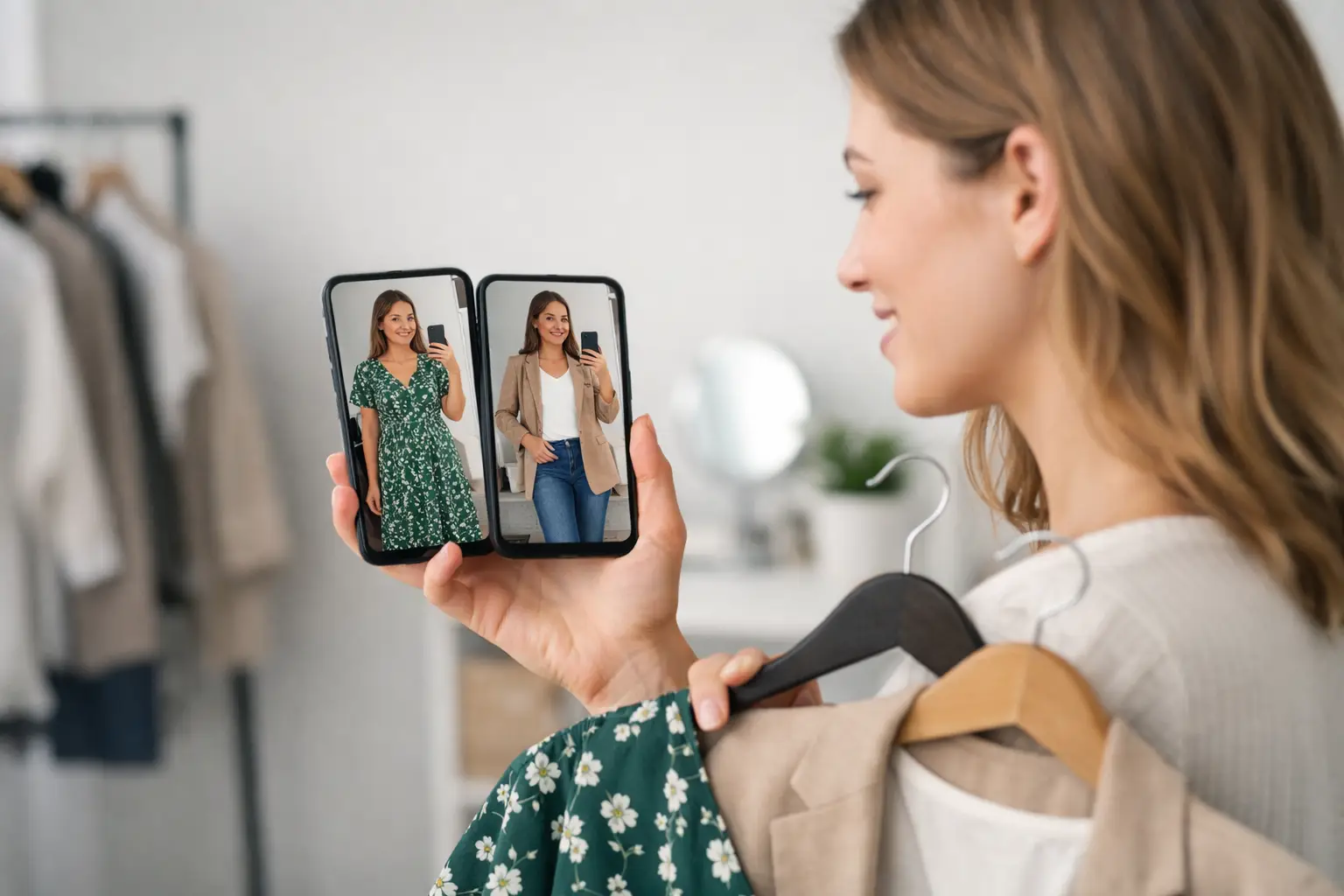
A mirror can tell you whether an outfit looks good. It is much less useful when you are trying to decide between three jackets, two pairs of jeans, and a cart full of items that will arrive on different days. Learning how to compare outfits on yourself means creating a fair, repeatable view of each option before you spend money.
The goal is not to find a universally “better” outfit. It is to see which one works better on your body, for your plans, and with the pieces you already own. When you compare looks consistently, the decision gets faster and return regret drops.
Start with the same version of you
Outfit comparisons only work when the conditions are similar. If you try one look under bright bathroom lighting and another during a rushed bedroom mirror check, color, proportions, and fit can look completely different.
Use the same full-body photo or the same mirror setup for every option. Stand straight and face forward first. Then check a slight angle and, if the outfit will be worn in motion, take a few steps or sit down. A dress that looks polished standing still may pull at the hips when you sit. Wide-leg pants can look balanced from the front but feel too long once you walk.
Keep the base layer consistent, too. Compare tops with the same bra or undershirt, and compare pants with the shoes you would actually wear. Changing several variables at once makes it harder to tell what is improving the outfit and what is creating visual noise.
Compare outfits on yourself side by side
Memory is not a reliable fitting room. You may remember a sweater as more flattering simply because it was the first one you tried, or because its product photo looked great. Side-by-side viewing cuts through that bias.
Put two looks next to each other and judge them on the same few details: fit, proportion, color, comfort, and usefulness. Start with the big picture before zooming in. Does the silhouette look balanced? Does the outfit create the shape you want? Is there a clear focal point, or are competing colors and layers making it feel busy?
A fast virtual try-on makes this easier when you are shopping online. Upload one clear full-body photo, test multiple garments against the same image, and compare the results without waiting for packages or changing clothes repeatedly. Prova uses advanced AI technology to generate realistic outfit views in about 10 seconds, so you can see options in a consistent format before buying.
Virtual try-on is strongest for comparing overall styling, color, length, and silhouette. It should support, not replace, practical fit checks such as measurements, fabric details, and reviews. A structured blazer may look sharp digitally but still feel restrictive across the shoulders. A knit may look ideal but run larger than expected. Use both signals before you check out.
Look at proportions before details
Most outfit decisions are made at a glance. Before worrying about buttons, jewelry, or a tiny pattern, assess where each garment begins and ends on your body.
A cropped jacket with high-rise pants can make the waist look more defined. The same jacket with low-rise, wide-leg jeans can shorten the torso. An oversized shirt can feel intentional when paired with fitted bottoms, but it may overwhelm the frame when worn with loose cargo pants.
There is no single “right” proportion. It depends on the look you want. The important question is whether the proportions look deliberate. If one outfit seems off, try changing only one piece at a time. Tuck the top, swap the shoe, or test a different rise in the pants. Small shifts often solve what initially feels like a full-outfit problem.
Check color near your face
The color closest to your face has an outsized effect. Compare similar tops, jackets, or scarves without changing your lighting. Ask whether each color makes your skin look clearer and your eyes more noticeable, or whether it emphasizes shadows and uneven tone.
Do not reject a favorite color just because it is not your most flattering shade. A bright color can be exactly right for a concert, vacation, or social post. But if you are choosing an everyday work top, a color that looks fresh with minimal effort is usually the smarter repeat purchase.
Also compare the outfit’s contrast level. High contrast, such as a white top with black pants, looks crisp and graphic. Lower contrast, such as cream with camel or navy with denim, tends to look softer. Neither is better. High contrast often reads bolder; low contrast can feel more relaxed and cohesive.
Judge each look for the real occasion
A great outfit for brunch can be the wrong outfit for a long flight. Before choosing a winner, give each look a job.
For work, consider whether you can move, sit, and layer comfortably. For a date, ask whether the outfit feels like you, not just like a trend you saw online. For travel, think about temperature changes, wrinkles, pockets, and shoe comfort. For an event, make sure the styling level matches the setting rather than relying on the product description alone.
This is where many impulse purchases fail. A garment can look excellent in isolation but have nowhere to go in your actual life. The better option is usually the one you can name at least three occasions to wear.
Add your existing wardrobe to the test
Do not compare a new top only against another new top. Compare it against what is already hanging in your closet. A piece that works with your favorite jeans, one reliable layer, and two pairs of shoes has more value than a slightly more exciting item that requires a new outfit around it.
Try each candidate with your most-worn basics. If you are considering a blazer, test it with your everyday denim, black pants, and the top you wear most often. If you are deciding on shoes, check them with the hemlines and bag colors you already own.
Saved outfit views are especially useful here. Build a small digital wardrobe of looks you have already tested, then return to them when a new item catches your eye. You will spot duplicate purchases faster and see which colors, cuts, and combinations you actually reach for.
Use a simple decision rule when both look good
Sometimes two outfits genuinely work. In that case, stop searching for a perfect answer and choose based on value.
Pick the option that feels more comfortable, works with more pieces you own, and fits the occasion with less effort. If those factors are tied, choose the one you would be excited to wear again next week. Rewear potential matters more than a one-time “wow” moment for most purchases.
If you are still stuck, take a short break before deciding. Looking again with fresh eyes can reveal that one outfit has better balance, while the other was only winning because it was newer or louder. You can also share the side-by-side options with a friend, but ask a specific question such as, “Which jacket looks more balanced with these pants?” Vague opinions create vague answers.
Avoid the comparison traps that lead to returns
The biggest mistake is treating a product image as proof. Retail photos are styled with ideal lighting, selected poses, and accessories that may not be included. Use them for inspiration, then bring the comparison back to your own body and wardrobe.
Another trap is judging only the front view. Check the side profile, back, sleeve length, neckline, and where the hem lands. These are the details that affect how an outfit feels all day and how it appears in candid photos.
Finally, do not force an item to win because it is on sale. A discount does not make an awkward fit more wearable. If you need to talk yourself into it after a clear side-by-side comparison, leave it in the cart.
The best outfit decision should feel simple: you can picture where you will wear it, what you will pair it with, and how you will feel when you catch your reflection. That is the kind of confidence worth buying.