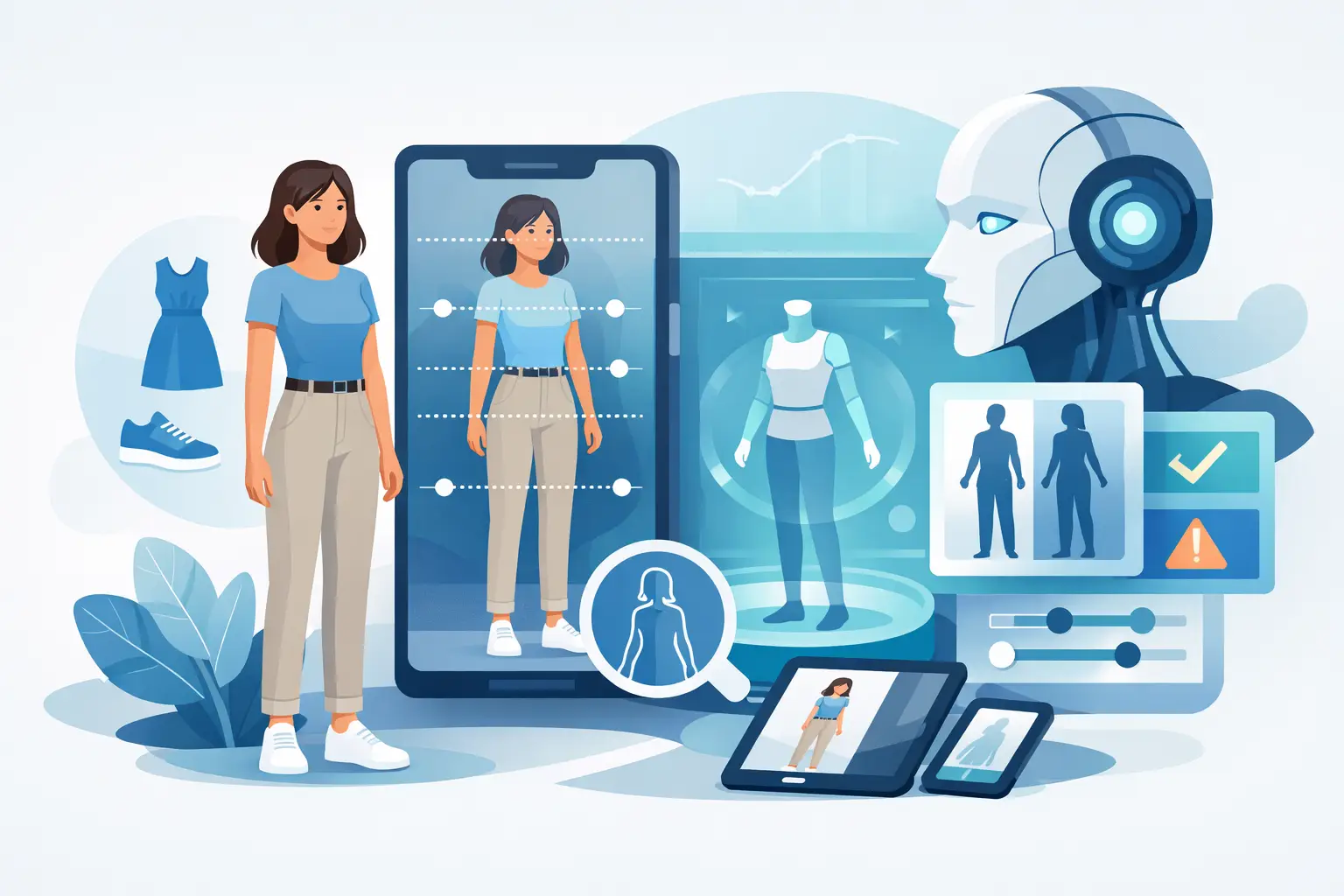
If you’ve ever added two sizes to cart, ordered both, and planned to return one later, you’re asking the right question: can AI show outfit fit in a way that’s actually useful? The short answer is yes - with the right system, AI can give you a realistic preview of how clothing will look on your body, how pieces work together, and whether an outfit feels right before you spend money.
That matters because most shopping friction starts before checkout. You’re not just wondering whether a dress is cute or a jacket is trending. You’re trying to predict drape, balance, length, shape, and whether the whole look works on you, not on a model with different proportions.
Can AI show outfit fit accurately?
AI can show outfit fit surprisingly well, but accuracy depends on what you expect it to do. If you want a digital fitting room that helps you judge overall appearance, silhouette, styling, and proportion, today’s virtual try-on technology is strong. If you want a guaranteed measurement-level promise that a waistband will feel exactly right at 2 p.m. after lunch, that’s a different standard.
This is where people often mix up two separate ideas: fit prediction and fit visualization. Fit prediction is about sizing data, body measurements, and brand variation. Fit visualization is about showing how a garment appears on your body in a realistic image. The best AI shopping tools focus on visualization first because that’s what most shoppers need to make faster decisions.
A realistic virtual try-on can answer the questions that usually cause hesitation. Does this oversized blazer still look sharp on my frame? Are these wide-leg pants flattering with my sneakers? Is this top too cropped with these jeans? Those are visual decisions, and AI is increasingly good at helping with them.
What AI is actually showing you
When AI generates an outfit preview, it is not physically stretching fabric over your body in real space. It is using image processing, body-aware modeling, garment mapping, and visual rendering to create a realistic representation of how clothing may look on you. That distinction matters because it explains both the strength and the limit of the experience.
The strength is speed and clarity. Instead of guessing from flat product shots, you can see a personalized image in seconds. That reduces a huge amount of uncertainty right away.
The limit is that some details still depend on the source image, the garment image, fabric complexity, and how the system handles folds, structure, and layering. A stiff denim jacket, a bodycon knit dress, and a flowing satin skirt all behave differently. AI can represent these differences visually, but some garments are easier to simulate convincingly than others.
That doesn’t make the preview less valuable. It means you should use it for what it does best: checking silhouette, placement, styling, and overall confidence before buying.
Where AI outfit fit helps most
The biggest win is decision speed. Most shoppers do not need perfect digital physics. They need to know whether something is worth ordering at all. AI helps you filter faster.
This is especially useful for categories where visual fit drives the purchase. Dresses, tops, jackets, denim, activewear, and full outfits benefit because shape and proportion are central to the decision. If you’re building a look rather than buying a single basic item, seeing pieces together on your body is even more valuable.
It also helps with styling confidence. A lot of returns happen because the item technically fits, but the look feels off. Maybe the hem hits at an awkward point. Maybe the volume on top and bottom doesn’t balance. Maybe the color works online but not against your skin tone and existing wardrobe. AI can surface those problems before checkout.
For frequent online shoppers, this changes the entire flow. You stop treating your home like a fitting room. You make fewer maybe-purchases and more deliberate ones.
Where AI still has limits
The honest answer to can AI show outfit fit is yes, but not perfectly in every scenario. There are trade-offs.
Compression garments, intricate textures, highly reflective fabrics, and unusual cuts can be harder to visualize with full realism. The same goes for garments where comfort matters as much as appearance, like bras, tailored trousers, or very structured pieces. A visual preview can tell you a lot, but it cannot fully replace touch, stretch, or the physical feel of movement.
Sizing inconsistency across brands is another challenge. An AI preview may show a style that looks right, while the actual item still runs small or large. That’s why the best shopping decision usually combines visual try-on with the brand’s size chart and product notes.
Photo quality matters too. A clear, full-body photo with natural posture gives better results than a dim mirror selfie with half the body cropped out. Better inputs lead to better outputs.
Why this is still a major step forward
Even with those limits, virtual try-on solves a problem that standard e-commerce never fixed. Product photography is aspirational, not personal. Size charts are technical, not visual. Reviews are inconsistent, and model measurements rarely help enough.
AI closes the gap by making the shopping experience personal at the moment it matters. You get a visual answer based on your body, your proportions, and your outfit choices. That shifts online shopping from educated guesswork to something much closer to real decision support.
For shoppers, the benefit is simple: less hesitation, fewer bad buys, and fewer returns. For anyone who shops often, that adds up fast.
What to look for in an AI try-on app
Not every tool that claims virtual try-on delivers a useful fit preview. Some results look generic. Some are slow enough that the process becomes annoying. Some raise privacy questions that should make any shopper pause.
A strong AI try-on app should do three things well. First, it should create realistic results fast enough that you actually use it while shopping. Waiting several minutes kills the experience. Second, it should make privacy clear and specific. Your photos should be handled over encrypted connections and not stored longer than necessary. Third, it should help you manage outfit decisions over time, not just generate a one-off image.
That’s where a product like Prova stands out. The app can generate realistic virtual try-ons in about 10 seconds, uses encrypted processing with automatic photo deletion, and lets you save looks in My Wardrobe so you can compare outfits instead of making rushed decisions in one sitting.
That combination matters more than people think. Speed gets you to the answer. Security gets you to trust. Saved outfits get you to better choices.
Can AI show outfit fit well enough to reduce returns?
In many cases, yes. Not because AI eliminates every fit issue, but because it removes a big chunk of uncertainty before purchase. A lot of returns are not true size failures. They’re expectation failures. The item looked different on the body than the shopper imagined.
AI helps correct that gap early. If the silhouette feels wrong, if the length is unflattering, or if the outfit just doesn’t work, you can catch it before the buy button. That alone can reduce unnecessary orders.
The strongest use case is not replacing every fitting room forever. It’s improving the first decision. Should I buy this? Should I buy this in this color? Should I pair it with what I already own? Should I skip it and keep scrolling? Those are high-frequency questions, and AI is very good at helping with them.
The real answer shoppers need
So, can AI show outfit fit? Yes - well enough to make online shopping faster, smarter, and much more confident. It can show how clothes are likely to look on your body, reveal proportion and styling issues early, and help you avoid purchases that were always headed for the return pile.
You should still keep your expectations grounded. AI is best used as a visual decision tool, not a perfect substitute for every physical detail of wearing a garment. But that’s not a weakness. It’s the practical reason the technology is useful right now.
If an app can show you a realistic look in seconds, protect your photo privacy, and help you compare outfits before you buy, that’s not a gimmick. That’s a better way to shop.
The smartest way to use AI is not to expect magic. It’s to use it for what it already does exceptionally well - giving you a clearer answer before you commit.